Showing posts with label WWI. Show all posts

Sunday, 1 December 2013

Christmas Cheer


Christmas postcards are quite lovely, don't you think? A simple way to reach across the miles...even though we have email and Facebook and Twitter now, there's still something special about sending something in the mail. Equally fun is using fountain pens, but that's another topic as well.

But pens and postcards have one thing in common- they require one to be able to write. Both in the literal and figurative sense, one must be able to put pen to paper and make it happen, then slap a stamp on it and march down to the post box and drop it in. It all shows thought and intention, which is why it means more today than it likely did in 1910, because there seems to be so little time for such genteel arts anymore.

Though really, it is still preferable living with electricity and municipal snow removal and weekly garbage collection even if one has to give up daily use of pen and ink from an inkwell.


I think these are supposed to be Highland cattle in the postcard, which reads:

 " To Greet You  - When you hear the belfry's chime/ Think of me this Christmas time / Distance cannot hearts divide/ Joy be yours this Christmastide."

The card's inscription is, "Dear Friends Just a PC to wish you all a Merry Xmas & lucky New Year from G & N Keys"


Sunday, 13 January 2013

Houses of Parliament, London, circa 1910

Not a whole lot to say about  this one. It wasn't addressed or sent, so dating it is kind of a shot in the dark, based on the age of the rest of the collection.


The view is from the Thames, with I think scenic garbage barges(scows?) in the foreground.
Perhaps in Edwardian England, the travel slogan "COME TO LONDON, WE HAVE GARBAGE REMOVAL!" means more than it would today.

Also, not much luck recreating this angle in a more recent photo. What is clear from all of the old postcards is that about 97% of the greenery has been removed. No trees, no shrubs, no flower gardens...all paved over. PROGRESS.


To be fair,  the Palace of Westminster did get the bejeesus bombed out of it a couple of times, was on fire (more than once), and had to be rebuilt...odds are good that changes a place just a little.


Saturday, 12 January 2013

Lily Elsie - the Edwardian's plumed hat lady

Part of the fun of looking at the old postcards is in their ability to provide a snapshot of an era. Sometimes, it's just that- a snapshot, that leads to investigation of a particular show or star or place, that tells us a lot about what was going on.

In this postcard, it is of the famed Lily Elsie. It is a toss up in this collection of who is more popular, she or Gladys Cooper. Both feature very prominently in postcard photographs of the period. Lily Elsie was hugely popular starting around 1907, but retired in 1911, only resurfacing for the 'war effort' productions of WW1.

She died in 1962.
(For a great site dedicated to Lily Elsie, please visit www.lily-elsie.com.)
This postcard is actually headed to Morecambe (from Leeds), instead of the other way round. Change is a good as a rest.

"6/6/17
1 Firth Grove Beeston Leeds
Dear Elsie, Thanks ever so much for the PC [postcard] received. Hope you are having a good time& that you are feeling better. Hope you are having nice weather. Love from Doris"

Friday, 11 January 2013

More from Morecombe


Continuing the theme of 'seaside resorts', we have a postcard from Morecambe, which is a

This piece of backstory comes from (of course) the Morecambe wiki page:

"In 1846, the Morecambe Harbour and Railway Company was formed[2] to build a harbour on Morecambe Bay, close to the fishing village of Poulton-le-Sands, and a connecting railway. By 1850, the railway linked to Skipton, Keighley and Bradford in the West Riding of Yorkshire, and a settlement began to grow around the harbour and railway, to service the port and as a seaside resort. The settlement expanded to absorb Poulton, and the villages of Bare and Torrisholme. The settlement started to be referred to as "Morecambe", possibly after the harbour and railway. In 1889 the new name was officially adopted.
Morecambe was a thriving seaside resort in the mid-20th century. While the resort of Blackpool attracted holiday-makers predominantly from the Lancashire mill towns, Morecambe had more visitors from Yorkshire (due to its railway connection) and Scotland. Between 1956 and 1989 it was the home of the Miss Great Britain beauty contest."

This would make sense, given that this family was from the North of England, so Morecambe was likely a close alternative for your seaside needs; though to be fair, nothing about these seaside towns' beaches looks all that appealing to me! But I guess that doesn't matter if you're not going to swim.
 
 
 The reverse reads,
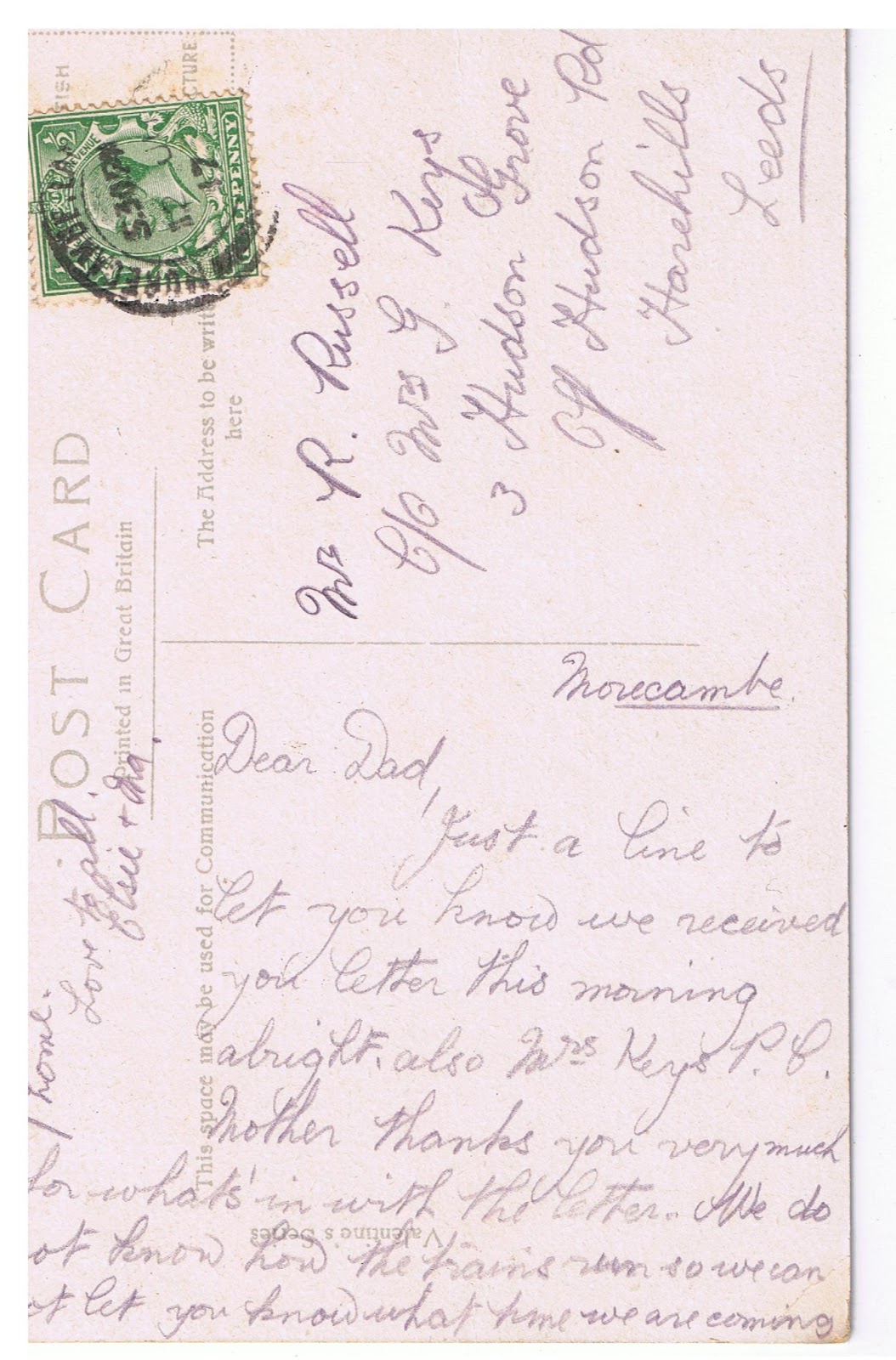
"Morecambe. Dear Dad, Just a line to let you know we received your letter this morning alright, also Mrs.Keys' P.C. [postcard]. Mother thanks you very much for what's in with the letter. We do not know how the trains run so we can not let you know what time we are coming home. Love to all, Elsie & Ina"


Postmarked Morecambe, Lancashire, 5:30 pm 12 June 1917.


Wednesday, 9 January 2013

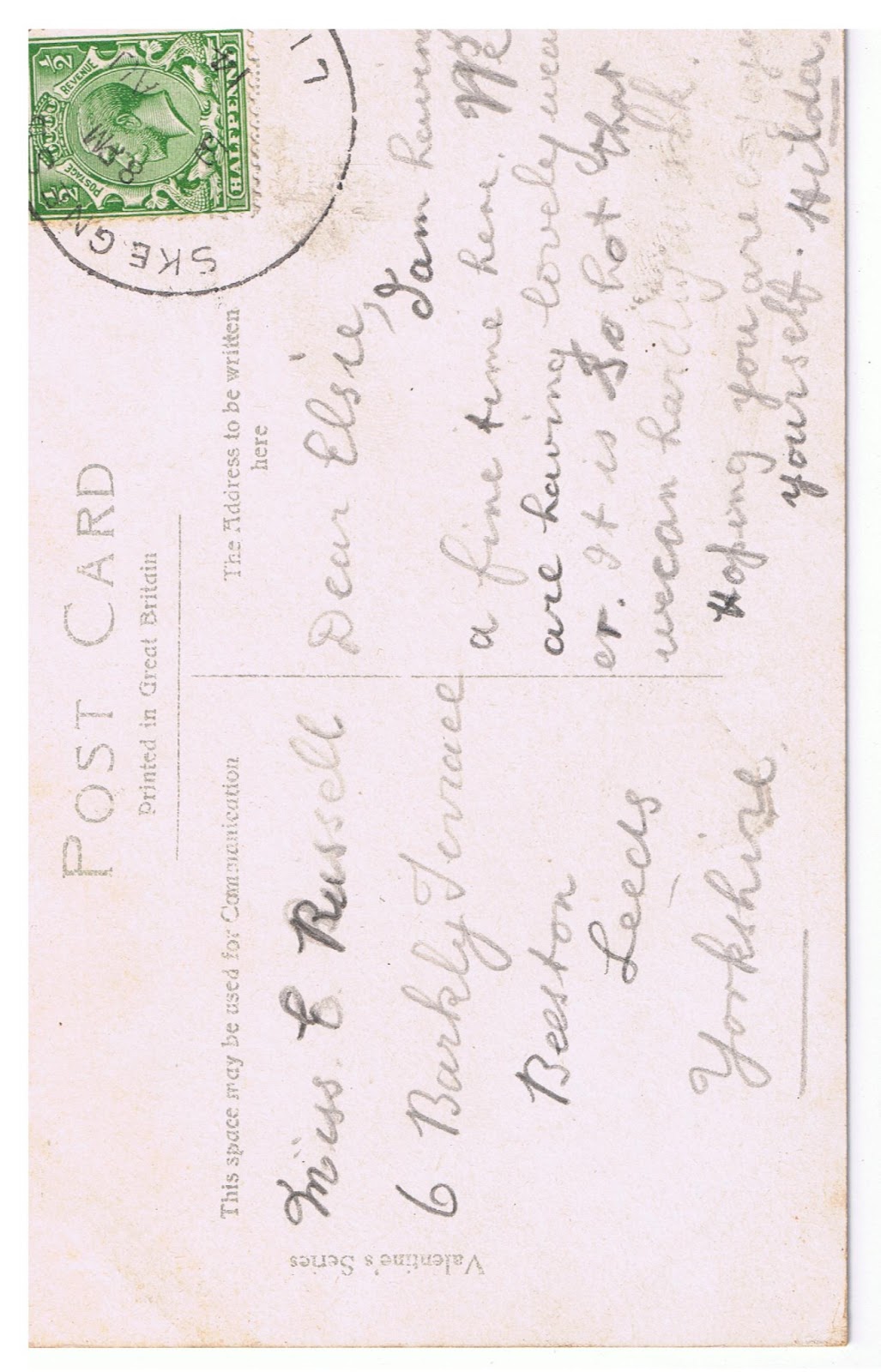
Greetings from Skegness

This installment comes from the seaside town of Skegness. Skegness was a seaside resort whose claim to fame was having one of the original 'holiday camps', Butlins,which opened there in 1936. The holiday camp experience was later made famous in the Britcom Hi-De-Hi.

The tower was built in1898 for the Jubilee (Queen Victoria), and it almost looks like this was under construction when the postcard photo was taken.
 

  The shot below is a more recent view, from the Skegness wiki:


The reverse of the postcard reads:


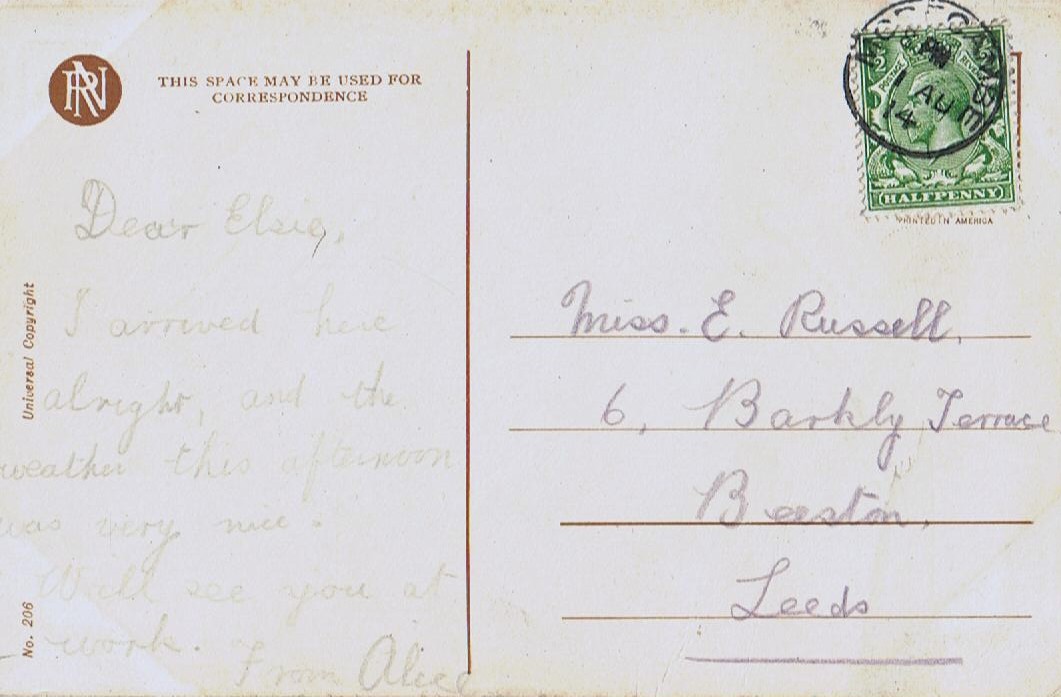
"Dear Elsie, I am having a fine time here. We are having lovely weather. It is so hot that we can hardly walk. Hoping you are enjoying yourself. Hilda."


Posted 8 pm, 3 Aug 1914.


Tuesday, 8 January 2013

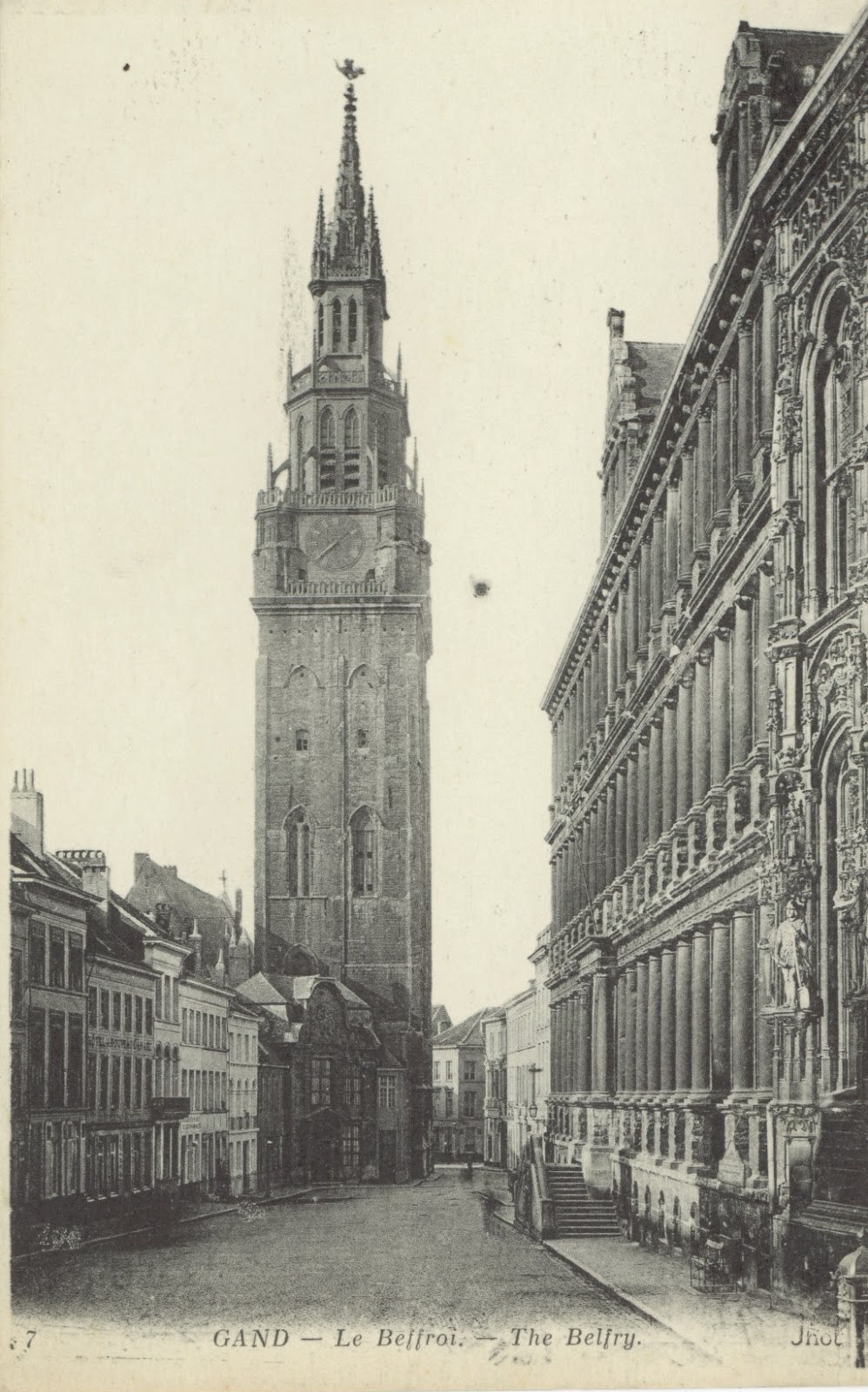
Gand- Ghent, Belgium

From the wiki:

"The 91-metre-high belfry of Ghent is one of three medieval towers that overlook the old city centre of Ghent, Belgium, the other two belonging to Saint Bavo Cathedral and Saint Nicholas' Church. Through the centuries, it has served not only as a bell tower to announce the time and various warnings, but also as a fortified watchtower[1] and town treasury.
Construction of the tower began in 1313 to the design of master mason Jan van Haelst, whose plans are still preserved in a museum. After continuing intermittently through wars, plagues and political turmoil, the work reached completion in 1380. It was near the end of this period that the gilded dragon, brought from Bruges,[1] assumed its place atop the tower. The uppermost parts of the building have been rebuilt several times, in part to accommodate the growing number of bells.
The primary bell in the tower, Roland, was the one used by citizens to warn of an enemy approaching or a battle won.[1] "Roland has become almost a person to the people of Belgium. He is a patriot, a hero, a leader in all rebellion against unrighteous authority."[1] Upon conquering Belgium, Charles V, Holy Roman Emperor ordered the removal of Roland. Henry Wadsworth Longfellow referred to Roland in one of his poems:
Till the bell of Ghent responded o'er lagoon and dike of sand,
I am Roland! I am Roland! there is victory in the land!

The belfry of Ghent, together with its attached buildings, belongs to the set of belfries of Belgium and France inscribed on UNESCO's World Heritage List."


This postcard would have been circa 1900 or so; hard to tell without dates on the postcards themselves (these weren't postmarked, and were in a batch).

You can take a tour of the tower still: there is a Bell Museum, open daily from 10- 6.


Sunday, 6 January 2013

Red painted postcard

This one is interesting. Interesting because there is so little to be said about the picture. If it's famous, I don't know of it; it looks like a pretty average landscape with a lot of red. It is a reproduction of an oil, as in the postcard you can see the brushstrokes reproduced.


The back of the card reads,
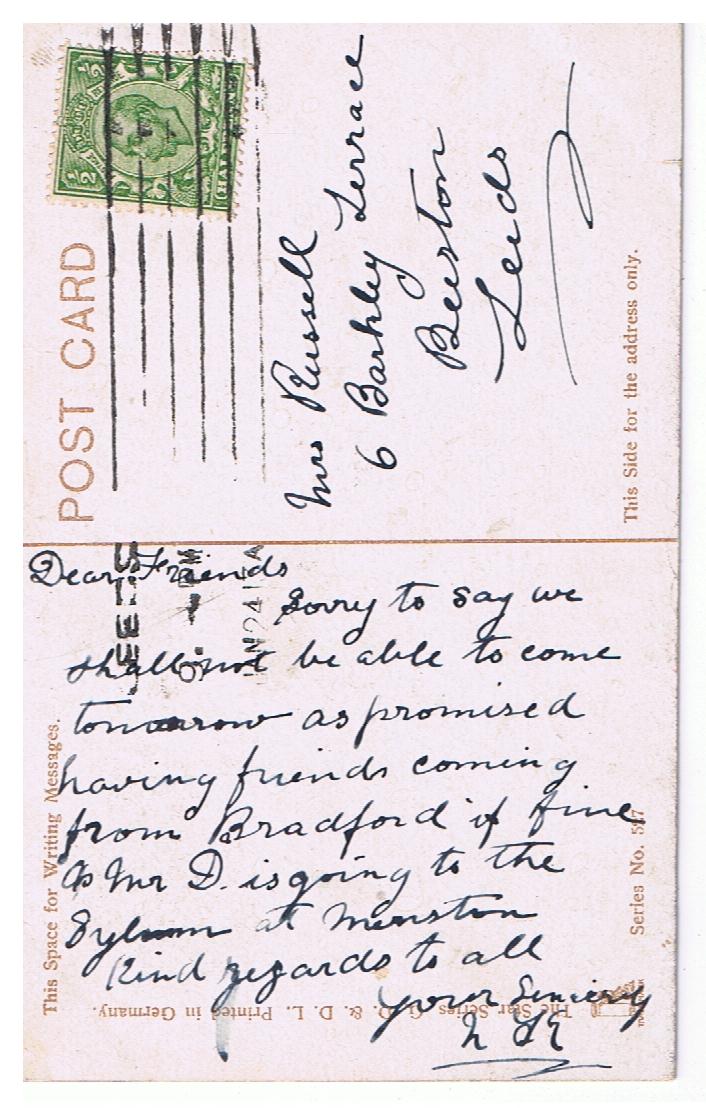
"Dear Friends, Sorry to say we shall not be able to come tomorrow as promised. having friends coming from Bradford if fine as Mr. D is going to the Sylum at Menston. Kind regards to all, your sincerely N LE."

After reading it a couple of times, the conclusion was that "Sylum" meant "asylum", and then figuring out penmanship to determine the place as 'Menston' made the process even easier.   The 'sylum was  "West Riding Pauper Lunatic Asylum" and apparently, the best place to be, as their approach to mental illness was fairly revolutionary at the time.


I sincerely hope that it turned out alright for "Mr. D", whether he was a doctor or a patient...or even a victim of PTSD.

A great photoset of the hospital can be found here on flickr.

Maison de la Reine

More from Versailles, this time, a postcard featuring 'la Maison de la Reine':


I stumbled upon some great contemporary pictures of this place here.


Another great site to visit is WorldVisit, which gives this description of the Hameau:

The petit hameau was small, a rustic but in essence ersatz farm (or ferme ornee) meant to evoke a peasant village in Normandy, built on the far side of a landscaped pond. Created in 1783, to designs of the Queen's favoured architect, Richard Mique, the hamlet was complete with farmhouse, dairy, and mill.

Here, it was said, the Queen and her attendants would dress as shepherdesses and milkmaids. Particularly docile, hand-picked cows would be cleaned. These cows would be milked by the ladies, with porcelain milk churns painted to imitate wood specially made by the royal porcelain manufacturer at Sèvres. These churns and pails featured the Queen's monogram. The simple and rustic ambiance at the petit hameau has been evoked in paintings by Fragonard; however, inside the farmhouse, the rooms were far from simple, featuring the luxury and comfort to which Marie Antoinette and her ladies were accustomed. Yet, the rooms at the petit hameau allowed for more intimacy than the grand salons at Versailles, or at the Petit Trianon itself. Such model farms operating under principles espoused by the Physiocrats, were fashionable among the French aristocracy at the time, and one primary purpose of the hameau was to add to the ambiance of the Petit Trianon, giving the illusion that the Trianon itself was deep in the countryside rather than within the confines of Versailles.

The garden surroundings of the Petit Trianon, of which the hameau de la Reine is an extension, began their transformation from formal pattern gardens to an informal "natural" garden of winding paths, curving canals and lakes in 1774, under the direction of Antoine Richard, gardener to the Queen. Richard Mique modified the landscape plan to provide vistas of lawn to west and north of the Petit Trianon, encircled by belts of trees. Beyond the lake to the north, the hameau was sited like a garden stage set, initially inspired in its grouping and vernacular building by Dutch and Flemish genre paintings, philosophically influenced by Rousseau's cult of "nature", and reflecting exactly contemporary picturesque garden principles set forth by Claude-Henri Watelet and by ideas of the philosophers, their "radical notions co-opted into innocent forms of pleasure and ingenious decoration" as William Adams has pointed out.

"An uninteresting architectural monument, perhaps, and fancifully restored ... a forerunner of nineteenth-century exposition pavilions and the modern theme park., Betsy Rosasco remarked : "during the Revolution a misogynistic, nationalistic and class-driven polemic swirled around the hameau, which had previously seemed a harmless agglomeration of playhouses in which to act out a Boucher pastorale".

The queen was accused by many of being frivolous, and found herself a target of innuendo, jealousy and gossip throughout her reign. For Marie Antoinette, this farm was an escape from the mounting horror of the real world, although to the French people having a queen that pretended to be a peasant for fun only made her image worse. She reigned supreme in this small area, and even the King only went there at her invitation.

Saturday, 5 January 2013

Parc du Petit-Trianon

This postcard comes from Versailles, according to the Wiki:

It was designed by Ange-Jacques Gabriel by the order of Louis XV for his long-term mistress, Madame de Pompadour, and was constructed between 1762 and 1768. But Madame de Pompadour died four years before its completion, and it was subsequently occupied by her successor, Madame du Barry. Upon his accession to the throne in 1774, the 20-year-old Louis XVI gave the château and its surrounding park to his 19-year-old Queen Marie Antoinette for her exclusive use and enjoyment. Marie longed to escape Louis and his court, and he gave her just the place.

Laiteries
Initially, there were two dairies: the "Preparation Dairy" which produced creams and cheeses, is located near the tower. It was where the milk was skimmed and the butter beaten. In the second dairy, the Queen tasted the dairy products from tables of veined white marble supported by fourteen carved consoles and arranged around the room.
The postcard then, if of the 'Preparation Dairy', since it's located near the Marlborough Tower.
I also found you can buy the image(!) I have posted.


While looking for information about this place, I stumbled upon another card from the Oakville Public Library with the same location, but from the opposite side:


It is about four years older than my postcard, having been sent in 1910...but who knows when the image was taken? They could well be of the same time, just produced as cards on different dates.

Friday, 4 January 2013

Cars

These are posted together, only because they both feature cars relatively prominently.

I have no idea what kind they are, so if anyone has a guess, feel free to post it in comments and the tags can be updated as well.


Postcards reverse reads 'Heliotypie E. Le Deley, 73 Rue Claude-Bernard Paris'.

Thursday, 3 January 2013

Resurrection

After a long hiatus, we're back to some posts - and postcards.
Work begins anew with the 'small book', a black book that features mostly European postcards from the time of World War I.
To modern eyes, it seems a bit strange that they are writing and asking about badges while the monstrosity of the 'Great War' rages around them, but I suppose that was how it was.
Many of these do not have inscriptions, and were never mailed. But to restart, I have found one that was addressed and sent from Paris to England October 19th, 1917 (at 16:45, no less!).


The inscription reads (as best I can tell):

"Dear Miss Russell,
Could you send me a Somerset Light Infantry badge? I do hope it's not troubling you too much in asking you that. How do you like this building. It is the theatre where only operas are played.
[sideways inscription]
Hoping to hear from you both soon Believe me dear Miss Russell yours sincerely Inez Geners*.

(*It's my guess at that last name, the writing needs better eyes than mine to decipher it.)

Sunday, 5 February 2012

INEZ!

From Belgium, circa 1910. Many of these postcards were printed before the war, so it's likely that the places named were significantly changed (or bombed flat).
Seems that Inez here had such a good time, she only had a quick moment to dash off her name and slap on some postage before getting  back to the thrill ride of La Fa Du Diable.

Also, 200 internets for those who remember what famous Belgian came from Spa.


Sunday, 29 January 2012

Made in Germany

Even though these postcards have no written in message, I think the reverse is still interesting for the place of manufacture.

Given that these were all mailed during the time of WWI, it is notable that the manufacture was often in Germany...'made at our facility in Bavaria' etc. There are one or two cards that have the place scratched out (in ink, by the sender), as clearly anti-German sentiment would have been running high.

I wonder what happened to the thousands of postcards printed for companies in Germany, like this one, after they were suddenly out of favour?

It's also too bad I can't really adequately post texture, as this is an example of engraved cards. I'd also like a larger version of this for my wall.


Friday, 27 January 2012

Corporation Street, Birmingham

Ah, how times have changed. This would be a text message now:


But text messages are neither this elegant nor durable.

Wednesday, 25 January 2012

Glorious Blackpool!

The first thing I did when I read the message was smile. I really hope it was the time of Mary's life, as we all know that things got really ugly from 1915-1919, then again about twenty years later.
Still, Blackpool might have been a nice diversion from all of that.


Sunday, 22 January 2012

The Winter Gardens of Yarmouth

This postcard is an aborted attempt to send something to Dear Mot[her]...but it would be lovely to see if the Winter Gardens of Yarmouth survived, and what they might look like today.
Unfortunately, I'm on the other side of the Atlantic and can't tell...


Eve of Destruction

It's funny, one always thinks of people in 'history' as knowing how it all would turn out. For example, we know that WWI lasted from 1914-1918 (or 19), and we know exactly when it began, and what the consequences would be.
But Alice didn't know. And Elsie didn't know.
Frankly, it's eerie to be scanning these sometimes, knowing what we know now...realizing that someone is writing to their friend three days before the world- their world- changes forever with the outbreak of WW1.
I only hope, as I relieve my childhood memories of looking at these postcards, that the writers and recipients were truly having 'the time of their lives' as described on their notes to each other. Not everyone came home, in fact, lots of men never came back at all, which is why people like Elsie ended up with Canadian soliders, emigrating as they did after the first war.
Sometimes I wonder if, a hundred years from now, someone will stumble upon our words and wonder the same thing: "did she know what would happen?".

"You had better live your best and act your best and think your best today; for today is the sure preparation for tomorrow and all the other tomorrows that follow.  Harriet Martineau


Saturday, 21 January 2012

Not a postcard, strictly speaking


This was among the collection of postcards. Some things I have provenance for, some are a little murkier. This is written on quite lovely linen paper (why it's survived a war and a hundred years), and reads:
May 15, 1918
Dear All,
Many thanks of letter & parcel that arrived yesterday though I notice that it is the old address. 13 Observation Group, F.S.C. etc. is my latest one. Well this drawing was done in my spare time about 3 weeks ago, and has lately been decorating the dug-out, but my pal would put pints of Creosol on the fire at once, with the result that he fired the roof, then he drowned my possessions. One slingy spot reached this, so I thought I'd let you have it & you can try & solve the puzzle:- Find the man that fell overboard. Let me know if you can; if not I'll tell you the result. Well, the weather has changed to rain, but I'm still in the pink & hope you are.
Remember me to all, and wait for the stuff from London.

aff Lov [affection and love?] RSR

Note: the brown spotches on the letter are the aforementioned Creosol (creosote).

Wishes

There are many themes throughout this postcard collection: Gladys Cooper, Devastation of War, Christmas Greetings, Easter Greetings, and Well Wishes. These are from the Well Wishes section (and believe me, they said it a LOT, it must have been a heck of a time to be a postal worker, with all these postcards zipping about).

Portions of the postcard collection have not been addressed or stamped, and are in fairly pristine condition. Some have been sent through the mail, so it's quite interesting to read the backs of them sometimes, for both the penmanship and sentiments. For any of those  that I think might be interesting to fellow voyeurs like myself, I will also include the back of the postcard.


Georgian Postcards live again

I've started this site to publish images from a collection of postcards I inherited from my grandfather. I remembered loving these as a child, looking at the still bright images from a place so far away, and hearing all about the 'Great War' in which both sides of my family had fought.

I have a whole section of postcards from Belgium and France during World War I, mostly they document the destruction that happened, and the horror of the aftermath. I chose not to start with these, but instead with one I found fascinating. I am hoping to put up at least one, and hopefully two, postcards each day until the entire collection is online. Perhaps they'll be of interest to fellow font-junkies like myself, who love finding period typeface.

There are many like this one: they feature popular symbols for luck, including the swastika. Having been born in a 'anything-with-a-swastika-is-evil' world, it's amazing to see them in their former glory. And also drives home the fact that the symbol itself was chosen for luck. To a small child, this was an interesting history lesson- and one I never forgot.