Showing posts with label vintage postcard. Show all posts

Sunday, 1 December 2013

Christmas Cheer


Christmas postcards are quite lovely, don't you think? A simple way to reach across the miles...even though we have email and Facebook and Twitter now, there's still something special about sending something in the mail. Equally fun is using fountain pens, but that's another topic as well.

But pens and postcards have one thing in common- they require one to be able to write. Both in the literal and figurative sense, one must be able to put pen to paper and make it happen, then slap a stamp on it and march down to the post box and drop it in. It all shows thought and intention, which is why it means more today than it likely did in 1910, because there seems to be so little time for such genteel arts anymore.

Though really, it is still preferable living with electricity and municipal snow removal and weekly garbage collection even if one has to give up daily use of pen and ink from an inkwell.


I think these are supposed to be Highland cattle in the postcard, which reads:

 " To Greet You  - When you hear the belfry's chime/ Think of me this Christmas time / Distance cannot hearts divide/ Joy be yours this Christmastide."

The card's inscription is, "Dear Friends Just a PC to wish you all a Merry Xmas & lucky New Year from G & N Keys"


Wednesday, 16 January 2013

Merry (belated) Christmas

If only these could be scanned in a calendar-appropriate order, life would be grand. But that's not how they show up, so they're posted as they appear. The hundred-year-old paper holding them is falling apart, so often they are hanging about in boxes, waiting to be scanned.

This one features the epitome of the Edwardian lady...ostrich plume, extravagant hat (thanks, Lily Elsie!)and wrapped in an ermine scarf and carrying a matching ermine purse. That's a LOT of ermine (which are really quite small while still wearing their own coats).

Puzzlingly, she is holding an umbrella, but that could just be a Canadian view of things: generally, snow here is a little more than an umbrella could handle.

Nonetheless, it's a charming card, worthy of not for the sweeping Beaux Arts font alone.


No inscription or postmark, undated.

Tuesday, 15 January 2013

The Golden Era


The glowing ease of the "Golden Era", which would come to a crashing end just four years later. A quick postcard about a lovely holiday, and a life of relative ease
.
Though you know, no antibiotics yet, so probably not all that great after all.


"Dear Elsie, Edna thanks you very much for your pretty PC [postcard]. Edna is having a happy time. Hoping you are well & enjoying your holidays. Love & kisses from Edna and her mother."

postmarked 19 July, 1910.

Monday, 14 January 2013

Otley from the Chevin


It seemed like a wild guess as to what language the caption was in- originally, "Olley" was in the running, and might have been plausible as it was in France, where a number of other cards are from.
However, the deciphering of "the Chevin" was the key. The Chevin is the name given to the ridge on the south side of Wharfedale in Leeds, West Yorkshire, England, overlooking the market town of Otley.
According to the wiki:
"Otley's name is derived from Othe, Otho or Otta, a Saxon personal name and leah, a woodland clearing in Old English. It was recorded as Ottanlege in 972 and Otelai or Othelia in the Domesday Book of 1086.[2][3] The name Chevin has close parallels to the Welsh term Cefn meaning ridge and may be a survival of the ancient Cumbric language."


At the time of this postcard, Otley would have been mostly mills: wool and paper, with printing being one of the main industries.


Sunday, 13 January 2013

Houses of Parliament, London, circa 1910

Not a whole lot to say about  this one. It wasn't addressed or sent, so dating it is kind of a shot in the dark, based on the age of the rest of the collection.


The view is from the Thames, with I think scenic garbage barges(scows?) in the foreground.
Perhaps in Edwardian England, the travel slogan "COME TO LONDON, WE HAVE GARBAGE REMOVAL!" means more than it would today.

Also, not much luck recreating this angle in a more recent photo. What is clear from all of the old postcards is that about 97% of the greenery has been removed. No trees, no shrubs, no flower gardens...all paved over. PROGRESS.


To be fair,  the Palace of Westminster did get the bejeesus bombed out of it a couple of times, was on fire (more than once), and had to be rebuilt...odds are good that changes a place just a little.


Saturday, 12 January 2013

Lily Elsie - the Edwardian's plumed hat lady

Part of the fun of looking at the old postcards is in their ability to provide a snapshot of an era. Sometimes, it's just that- a snapshot, that leads to investigation of a particular show or star or place, that tells us a lot about what was going on.

In this postcard, it is of the famed Lily Elsie. It is a toss up in this collection of who is more popular, she or Gladys Cooper. Both feature very prominently in postcard photographs of the period. Lily Elsie was hugely popular starting around 1907, but retired in 1911, only resurfacing for the 'war effort' productions of WW1.

She died in 1962.
(For a great site dedicated to Lily Elsie, please visit www.lily-elsie.com.)
This postcard is actually headed to Morecambe (from Leeds), instead of the other way round. Change is a good as a rest.

"6/6/17
1 Firth Grove Beeston Leeds
Dear Elsie, Thanks ever so much for the PC [postcard] received. Hope you are having a good time& that you are feeling better. Hope you are having nice weather. Love from Doris"

Tuesday, 8 January 2013

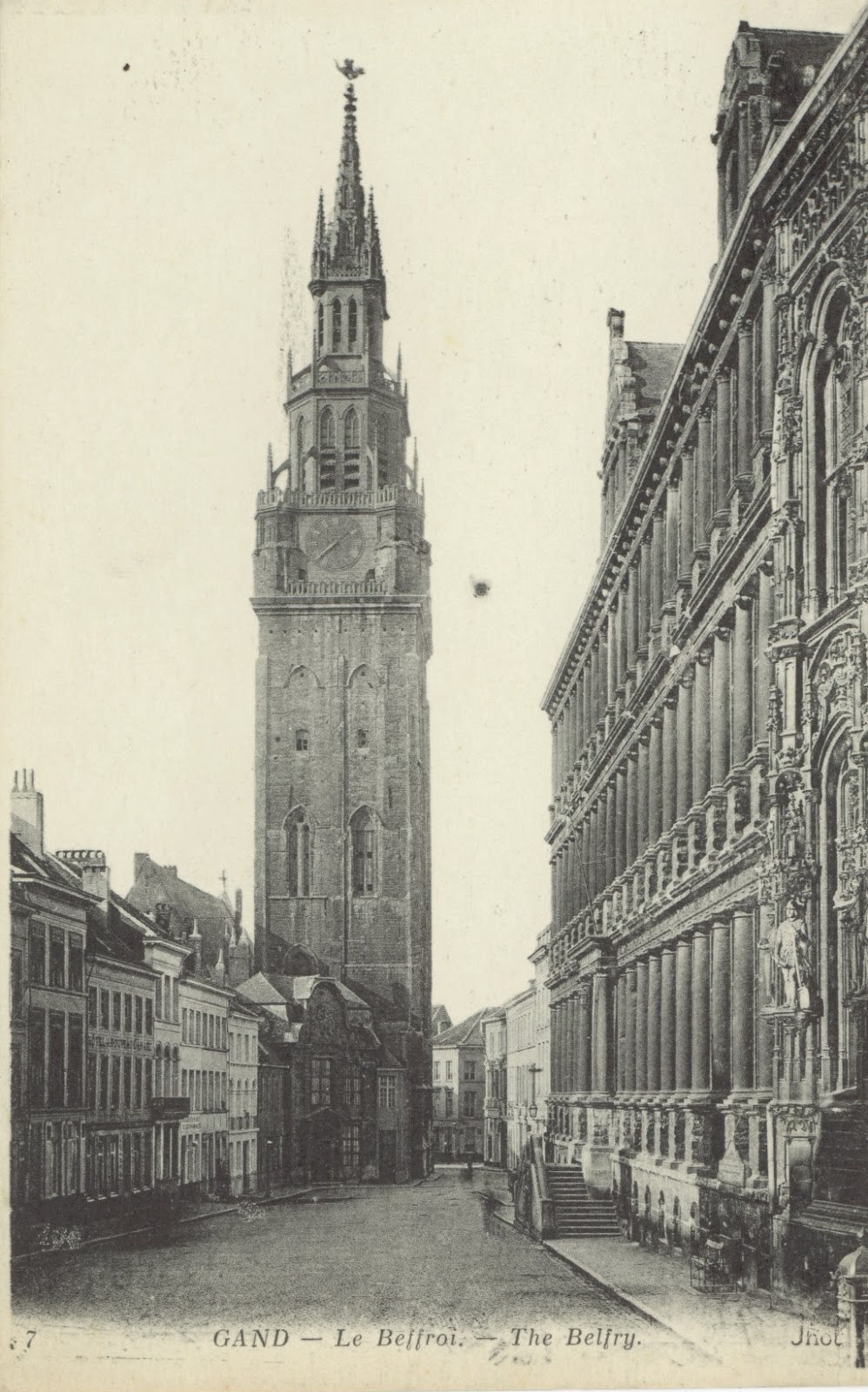
Gand- Ghent, Belgium

From the wiki:

"The 91-metre-high belfry of Ghent is one of three medieval towers that overlook the old city centre of Ghent, Belgium, the other two belonging to Saint Bavo Cathedral and Saint Nicholas' Church. Through the centuries, it has served not only as a bell tower to announce the time and various warnings, but also as a fortified watchtower[1] and town treasury.
Construction of the tower began in 1313 to the design of master mason Jan van Haelst, whose plans are still preserved in a museum. After continuing intermittently through wars, plagues and political turmoil, the work reached completion in 1380. It was near the end of this period that the gilded dragon, brought from Bruges,[1] assumed its place atop the tower. The uppermost parts of the building have been rebuilt several times, in part to accommodate the growing number of bells.
The primary bell in the tower, Roland, was the one used by citizens to warn of an enemy approaching or a battle won.[1] "Roland has become almost a person to the people of Belgium. He is a patriot, a hero, a leader in all rebellion against unrighteous authority."[1] Upon conquering Belgium, Charles V, Holy Roman Emperor ordered the removal of Roland. Henry Wadsworth Longfellow referred to Roland in one of his poems:
Till the bell of Ghent responded o'er lagoon and dike of sand,
I am Roland! I am Roland! there is victory in the land!

The belfry of Ghent, together with its attached buildings, belongs to the set of belfries of Belgium and France inscribed on UNESCO's World Heritage List."


This postcard would have been circa 1900 or so; hard to tell without dates on the postcards themselves (these weren't postmarked, and were in a batch).

You can take a tour of the tower still: there is a Bell Museum, open daily from 10- 6.


Monday, 7 January 2013

Gand Saint-Bavo's Cathedral -Ghent

The postcard for today comes from Gand (anglicized version of the name) of Gent , Belgium, and the Cathedral of Saint-Bavo.

Apparently, there was some interesting business that ensued after WWI, in which the Germans returned artwork that they had stolen, along with some that were legitimately purchased (by the King of Prussia) as 'recompense' for their destruction during the war. This of course annoyed them, and they set about re-stealing it about twenty years later, and hiding it in a salt mine. Bafflingly persistent, those Germans.

In this postcard, the main piece, van Eyck's Het Lam Gods, is absent, as it would not have been returned (yet) or restolen (by Hilter).

You can read more about the exciting times of the art of Saint-Bavon here, and about the mystery surronding the Ghent Altarpiece's whereabouts here.


For an almost identical shot of the interior as it stands, please visit the site for Sint-Baafskathedraal Gent. It's a wonderful site, and hopefully I'll be able to see this places in person one day.


Sunday, 6 January 2013

Maison de la Reine

More from Versailles, this time, a postcard featuring 'la Maison de la Reine':


I stumbled upon some great contemporary pictures of this place here.


Another great site to visit is WorldVisit, which gives this description of the Hameau:

The petit hameau was small, a rustic but in essence ersatz farm (or ferme ornee) meant to evoke a peasant village in Normandy, built on the far side of a landscaped pond. Created in 1783, to designs of the Queen's favoured architect, Richard Mique, the hamlet was complete with farmhouse, dairy, and mill.

Here, it was said, the Queen and her attendants would dress as shepherdesses and milkmaids. Particularly docile, hand-picked cows would be cleaned. These cows would be milked by the ladies, with porcelain milk churns painted to imitate wood specially made by the royal porcelain manufacturer at Sèvres. These churns and pails featured the Queen's monogram. The simple and rustic ambiance at the petit hameau has been evoked in paintings by Fragonard; however, inside the farmhouse, the rooms were far from simple, featuring the luxury and comfort to which Marie Antoinette and her ladies were accustomed. Yet, the rooms at the petit hameau allowed for more intimacy than the grand salons at Versailles, or at the Petit Trianon itself. Such model farms operating under principles espoused by the Physiocrats, were fashionable among the French aristocracy at the time, and one primary purpose of the hameau was to add to the ambiance of the Petit Trianon, giving the illusion that the Trianon itself was deep in the countryside rather than within the confines of Versailles.

The garden surroundings of the Petit Trianon, of which the hameau de la Reine is an extension, began their transformation from formal pattern gardens to an informal "natural" garden of winding paths, curving canals and lakes in 1774, under the direction of Antoine Richard, gardener to the Queen. Richard Mique modified the landscape plan to provide vistas of lawn to west and north of the Petit Trianon, encircled by belts of trees. Beyond the lake to the north, the hameau was sited like a garden stage set, initially inspired in its grouping and vernacular building by Dutch and Flemish genre paintings, philosophically influenced by Rousseau's cult of "nature", and reflecting exactly contemporary picturesque garden principles set forth by Claude-Henri Watelet and by ideas of the philosophers, their "radical notions co-opted into innocent forms of pleasure and ingenious decoration" as William Adams has pointed out.

"An uninteresting architectural monument, perhaps, and fancifully restored ... a forerunner of nineteenth-century exposition pavilions and the modern theme park., Betsy Rosasco remarked : "during the Revolution a misogynistic, nationalistic and class-driven polemic swirled around the hameau, which had previously seemed a harmless agglomeration of playhouses in which to act out a Boucher pastorale".

The queen was accused by many of being frivolous, and found herself a target of innuendo, jealousy and gossip throughout her reign. For Marie Antoinette, this farm was an escape from the mounting horror of the real world, although to the French people having a queen that pretended to be a peasant for fun only made her image worse. She reigned supreme in this small area, and even the King only went there at her invitation.

Saturday, 10 March 2012

Epic long time...

Since the last postcard offering.

So here's something I meant to post Valentine's Day. It took me a while to figure out that was a pillow not a hat.


Sunday, 5 February 2012

INEZ!

From Belgium, circa 1910. Many of these postcards were printed before the war, so it's likely that the places named were significantly changed (or bombed flat).
Seems that Inez here had such a good time, she only had a quick moment to dash off her name and slap on some postage before getting  back to the thrill ride of La Fa Du Diable.

Also, 200 internets for those who remember what famous Belgian came from Spa.


Sunday, 29 January 2012

Made in Germany

Even though these postcards have no written in message, I think the reverse is still interesting for the place of manufacture.

Given that these were all mailed during the time of WWI, it is notable that the manufacture was often in Germany...'made at our facility in Bavaria' etc. There are one or two cards that have the place scratched out (in ink, by the sender), as clearly anti-German sentiment would have been running high.

I wonder what happened to the thousands of postcards printed for companies in Germany, like this one, after they were suddenly out of favour?

It's also too bad I can't really adequately post texture, as this is an example of engraved cards. I'd also like a larger version of this for my wall.


Friday, 27 January 2012

Corporation Street, Birmingham

Ah, how times have changed. This would be a text message now:


But text messages are neither this elegant nor durable.

Wednesday, 25 January 2012

Glorious Blackpool!

The first thing I did when I read the message was smile. I really hope it was the time of Mary's life, as we all know that things got really ugly from 1915-1919, then again about twenty years later.
Still, Blackpool might have been a nice diversion from all of that.


Monday, 23 January 2012

Adel Church, Leeds

Adel Church, Leeds is the subject of this lovely postcard, sent to Elsie by her friend M. Keys. The thought is that Elsie and her family would know this church well, as she was from Leeds, and this may have even been their home parish.

Happily, Adel Church still exists, and looks pretty much as it has since the time of Normans. The church even has a tech-savvy website, where you can find out more information.
.
If you're wondering about the absence of postage, it seems that many of these cards were mailed in envelopes, perhaps more than one at a time. Sadly, I do not have the envelopes, but the postcards remain.

Sunday, 22 January 2012

The Winter Gardens of Yarmouth

This postcard is an aborted attempt to send something to Dear Mot[her]...but it would be lovely to see if the Winter Gardens of Yarmouth survived, and what they might look like today.
Unfortunately, I'm on the other side of the Atlantic and can't tell...


Eve of Destruction

It's funny, one always thinks of people in 'history' as knowing how it all would turn out. For example, we know that WWI lasted from 1914-1918 (or 19), and we know exactly when it began, and what the consequences would be.
But Alice didn't know. And Elsie didn't know.
Frankly, it's eerie to be scanning these sometimes, knowing what we know now...realizing that someone is writing to their friend three days before the world- their world- changes forever with the outbreak of WW1.
I only hope, as I relieve my childhood memories of looking at these postcards, that the writers and recipients were truly having 'the time of their lives' as described on their notes to each other. Not everyone came home, in fact, lots of men never came back at all, which is why people like Elsie ended up with Canadian soliders, emigrating as they did after the first war.
Sometimes I wonder if, a hundred years from now, someone will stumble upon our words and wonder the same thing: "did she know what would happen?".

"You had better live your best and act your best and think your best today; for today is the sure preparation for tomorrow and all the other tomorrows that follow.  Harriet Martineau


The why

My husband asked me today, "Why are you doing this? How will anyone know it even exists?". I suppose those are valid points, because I haven't figured out how to let other people know. Maybe, while I cruise favourite places like Retronaut, my tag line will lead a few people here. I think in the end what matters to me is that I have put these images out there: 'there' being the wide world of our beloved interwebs, where maybe someone will happen on it by happy surprise in the same way I find the bulk of my fun-things-to-look-at. And maybe by committing these to the web they will continue to exist long after any potential physical disaster befalls the actual postcards themselves (though they've made it a hundred years so far).
I have to believe there are other History Creepers like me out there, that enjoy looking at things that remind us that our ancesors were human and had their own full-colour world, and weren't just static black-and-white figures in a history book.

The sights of Birmingham

 These were from a trip one of Elsie's friends took to Birmingham.
Seems Muriel had an okay time. I'm always amused at the almost inane conversations...no wonder in Canada we talk about the weather all the time!

Saturday, 21 January 2012

Wishes

There are many themes throughout this postcard collection: Gladys Cooper, Devastation of War, Christmas Greetings, Easter Greetings, and Well Wishes. These are from the Well Wishes section (and believe me, they said it a LOT, it must have been a heck of a time to be a postal worker, with all these postcards zipping about).

Portions of the postcard collection have not been addressed or stamped, and are in fairly pristine condition. Some have been sent through the mail, so it's quite interesting to read the backs of them sometimes, for both the penmanship and sentiments. For any of those  that I think might be interesting to fellow voyeurs like myself, I will also include the back of the postcard.